

Gullies. What they are and where to use them.


 Back
Drainage Gullies: What They Are and Where to Use Them
The term ‘gully’ is often used interchangeably to describe different drainage products, sometimes incorrectly. While this may seem like a matter of semantics, gullies have specific applications within a drainage system.
In this guide, we'll explain what drainage gullies are, the different types available and where they are typically used within a drainage project. We'll also look at how gully traps work, the differences between P-trap and bottle gullies, and some important installation and maintenance considerations.
What Is a Drainage Gully?
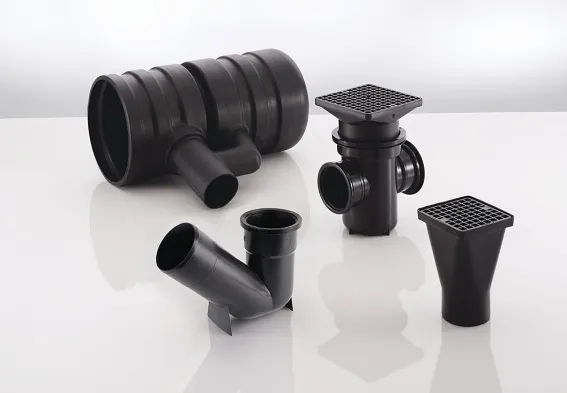
A gully is a drainage fitting with an open top to allow water to enter, a solid base to maintain its vertical position and an outlet that allows water to discharge into a drainage network.
Gullies are generally used in two distinct settings:
Road Gullies
Road gullies are installed at the lowest points of roads, highways and other impermeable surfaces, such as tarmac, paving and concrete. Their purpose is to collect surface water and discharge it into the drainage network.
As you might expect, road gullies are designed to handle large volumes of stormwater over short periods. They commonly feature wide openings of around 450mm and a large sump capacity to collect debris washed off the road surface.
Regular maintenance is essential. The debris collected within the sump should be emptied to prevent build-up and potential blockages within the drainage system.
Domestic Gullies
Domestic gullies are designed to collect water from a variety of sources. They are most commonly installed at the base of a downpipe, collecting rainwater from the roof while also capturing surface water from the surrounding area when positioned at a local low point.
In the UK, domestic gullies are also commonly used to discharge greywater from household appliances such as dishwashers and washing machines.
These gullies often incorporate a trap, which retains a small amount of water to create a water seal. This prevents unpleasant odours and gases from travelling back up through the drainage pipework.
What Are Gully Traps?
Although the term ‘gully trap’ is often used to describe the gully itself, it actually refers to an aspect of the gully's internal design.
While the exact design varies between different types of gully, the principle remains the same. Water flows down through the centre of the gully, into a basin and back up towards an outlet pipe connected to the drainage system.
When the flow of water stops, a small amount remains at the bottom of the gully, between the outlet and the central chamber. This retained water creates a seal that prevents unpleasant smells and gases from escaping back out of the drain.
The two most common types of gully trap are the P-trap gully and the bottle gully. Both perform the same fundamental function, but there are some important differences in their design, installation and maintenance.
P-Trap Gully
A P-trap gully is essentially a length of pipe moulded into a shape resembling the letter ‘P’. The curved section, often referred to as a U-bend, works in the same way as the U-bend beneath a kitchen sink.
The bend retains water, creating a seal between the gully opening and the wastewater further down the pipe. This prevents unpleasant gases produced by the decomposition of wastewater from travelling back up through the drainage system.
P-trap gullies are available with either a 90-degree or 45-degree outlet bend. They are most commonly used to collect rainwater from a downpipe when connected to a grated drainage fitting known as a hopper.
The main disadvantage of a P-trap gully is access for maintenance.
If the gully or the connected drain becomes blocked, it cannot be cleared using a drain rod in the conventional way.
Although the grated hopper or grid helps prevent leaves, twigs and other debris from entering the gully, smaller debris can still pass through. Over time, this material can accumulate and cause blockages within the gully or connected drainage pipework.
If this happens, a drainage specialist may be required. Unless the installation includes a rodding eye or suitable access point, clearing the blockage may require electro-mechanical pipe cleaning equipment.
Bottle Trap Gully
A bottle trap gully operates on the same principle as a P-trap, but its alternative design addresses one of the main maintenance limitations.
Unlike a P-trap, a bottle gully does not rely on a tight bend in the pipework to retain water. Instead, it uses a removable inner sleeve, or central chamber, which creates a space between the sleeve and the surrounding wall of the gully.
Water is forced up through this space to reach the outlet pipe. The retained water continues to provide a seal against unpleasant smells and gases.
The removable sleeve makes it easier to access the inside of the gully, allowing silt and debris to be removed by hand. It also provides direct access to the outlet for a drain rod if a blockage occurs within the connected pipework.
However, access can depend on the installation depth and whether additional components, such as a hopper and riser, are required to bring the gully up to surface level.
Bottle gullies are suitable for both rainwater and wastewater applications. They are commonly found around newer properties and are frequently used when replacing older gullies.
One particular variation is the Back Inlet Gully, which is especially suited to foul water systems as it can be connected to an existing drainage run. The outlet on this type of gully is positioned slightly lower than the inlet to help maintain the water seal.
Installing Domestic Drainage Gullies
Installing a domestic drainage gully is generally a straightforward process. However, if you're unsure whether your property has a combined or separate drainage system, we recommend consulting a qualified plumber before carrying out any installation work.
If you're planning to install a gully yourself, there are several important considerations:
Concrete bedding: All gullies should be installed on a bed of concrete to ensure they remain stable and maintain the correct level.
P-trap access: P-trap gully installations require a hopper head to collect water, along with a rodding eye or suitable access point to allow blockages in the connected drain to be cleared using a drain rod.
Domestic Gully Maintenance
Gullies are an essential part of a property's drainage system, and regular maintenance is important to keep them working effectively.
Keeping gullies clean and free from debris is one of the simplest ways to help prevent blockages. Fortunately, this can be incorporated into your usual external property maintenance routine.
Simple measures include regularly sweeping away debris around gully grids and clearing guttering a couple of times a year.
If you have any questions about drainage gullies that haven't been covered in this guide, contact United Civils Supplies. Our team is on hand to help with your drainage requirements.