
Plastic vs Clay vs Concrete Drainage Pipes:
Why Plastic Is the Smart Choice for Most Projects


 Back
Plastic vs Clay vs Concrete Drainage Pipes
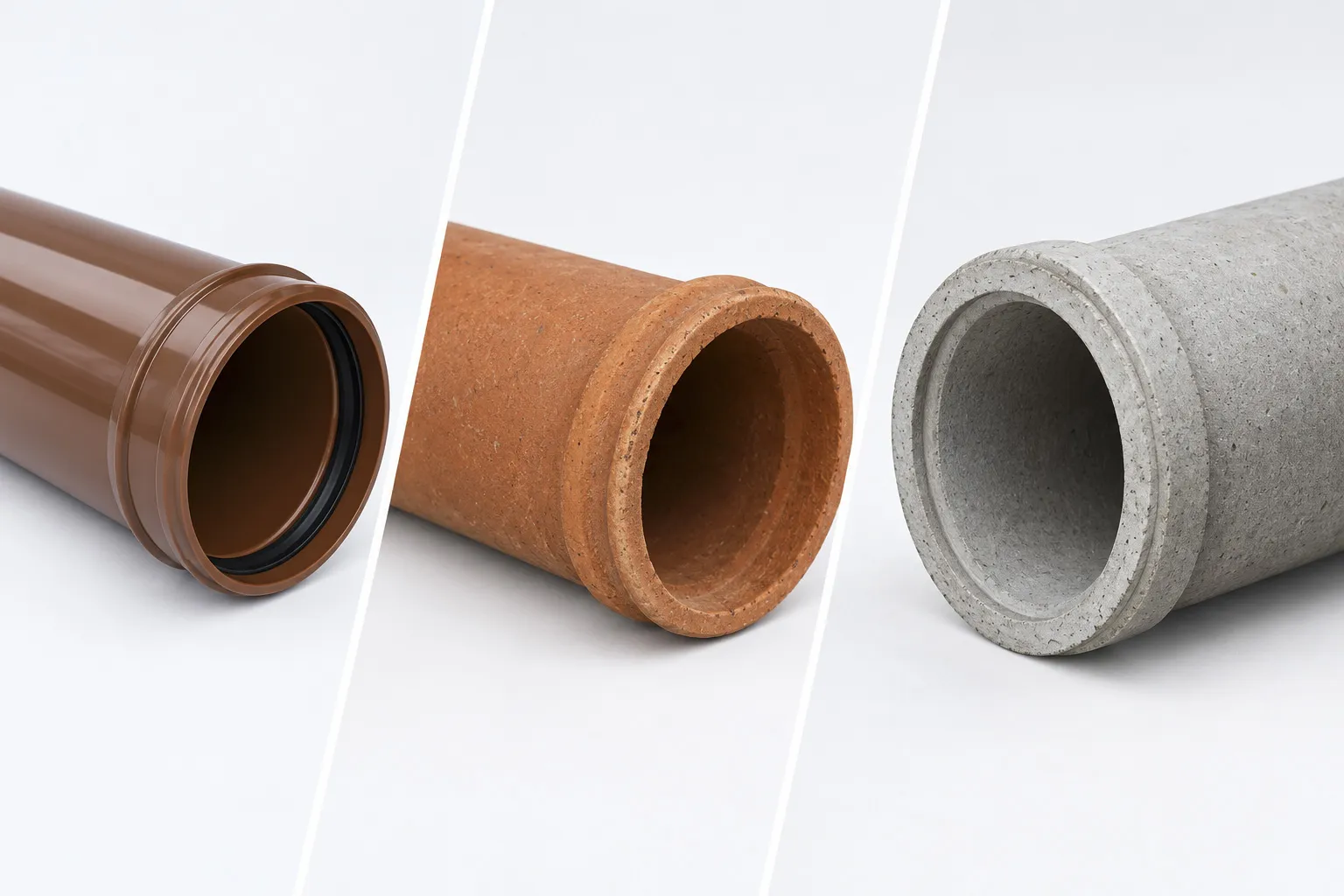
Choosing the right underground drainage system can make a significant difference to installation costs, site efficiency and long-term performance. With plastic, clay and concrete pipes all available, understanding their advantages is essential when specifying drainage for residential developments, commercial projects and wider civils works.
While traditional materials still have their place, plastic drainage has become a popular solution for modern construction, offering lightweight handling, straightforward installation and excellent value for money.
In this UCS Knowledge Hub guide, we compare plastic, clay and precast concrete drainage pipes to help you identify the most practical solution for your next project.
Why Is Plastic Drainage Becoming the Preferred Choice?
Plastic drainage pipes, particularly unplasticised polyvinyl chloride (PVC-U), are widely used in domestic and light commercial underground drainage systems. Their combination of practical handling, reliable jointing and competitive pricing makes them an attractive alternative to traditional materials.
1. Faster and More Efficient Installation
One of the biggest advantages of plastic drainage is its lightweight construction. Compared with clay and precast concrete, plastic pipes are easier to transport, manoeuvre and position within an excavation.
This can be particularly beneficial on restricted sites, housing developments and refurbishment projects where access is limited.
Plastic pipes are also available in longer lengths, meaning fewer joints may be required along a drainage run. Combined with push-fit joints and compatible fittings, this can simplify installation and reduce the time spent assembling the system.
For contractors, quicker installation can mean reduced labour requirements, improved site productivity and greater control over project schedules.
2. Lower Overall Installation Costs
Although the initial purchase price matters, the true cost of a drainage system includes much more than the pipe itself.
Plastic drainage can offer savings through:
- Competitive material prices.
- Reduced manual handling and transport demands.
- Fewer joints on longer pipe runs.
- Faster installation and lower associated labour costs.
- A broad selection of readily available fittings and accessories.
Clay pipes are heavier and generally require more careful handling, while larger precast concrete products often need mechanical lifting equipment.
For many domestic and light commercial applications, plastic provides an economical solution without compromising the performance required by the project.
3. Reliable Performance and Long-Term Durability
Modern PVC-U underground drainage pipes are designed for buried applications and can provide a long service life when correctly specified and installed.
Their smooth internal surfaces help wastewater and surface water flow efficiently, while appropriately designed push-fit joints create secure, watertight connections.
Plastic also offers some flexibility, allowing it to accommodate limited ground movement when supported by correctly installed bedding and sidefill.
However, flexibility does not eliminate the need for proper installation. Pipe stiffness, burial depth, groundwater conditions and traffic loading must all be considered to ensure the system performs as intended.
4. Versatile Solutions for Different Applications
Plastic drainage systems are available in a range of diameters, stiffness classes, bends, junctions, adaptors and access components.
This versatility makes them suitable for many applications, including:
- Domestic foul water drainage.
- Surface water drainage.
- New housing developments.
- Extensions and property renovations.
- Garden rooms and outbuildings.
- Light commercial drainage installations.
- Repairs and connections to existing drainage networks.
The availability of compatible components can also simplify alterations and future maintenance, helping contractors create complete drainage systems from a coordinated range of products.
Plastic vs Clay Drainage Pipes
Clay has a long history in underground drainage and remains valued for its compressive strength, abrasion resistance and resistance to many aggressive chemicals. Nevertheless, its weight and brittle nature can make installation more demanding.
Feature | Plastic drainage | Clay drainage |
Handling | Lightweight and easy to manoeuvre | Heavy and requires careful handling |
Installation | Quick push-fit jointing | More demanding handling and alignment |
Pipe lengths | Longer lengths can reduce joint numbers | Often supplied in shorter sections |
Ground movement | Can accommodate limited movement with correct support | Rigid and more vulnerable to cracking from uneven movement |
Chemical resistance | Suitable for many normal domestic applications | Excellent resistance to many aggressive substances |
Typical cost | Often lower installed cost for routine domestic work | Can involve higher handling and installation costs |
For most standard domestic installations, plastic offers a compelling combination of convenience, speed and affordability.
Clay may still be appropriate where chemical exposure is a concern, where a project specification requires it or where matching an existing drainage system is important.
For new extensions and replacement drainage, PVC-U can also be connected to existing clay pipework using suitable purpose-made adaptors or flexible couplings.
Plastic vs Precast Concrete Drainage Pipes
Precast concrete is a robust option for major infrastructure, heavily loaded areas and applications requiring substantial structural capacity. Its weight and strength can be advantageous in appropriately designed systems.
However, those same characteristics can introduce additional handling and installation requirements.
Plastic drainage offers a more manageable alternative for many smaller-scale projects, particularly where access, installation speed and cost control are priorities.
Feature | Plastic drainage | Precast concrete |
Handling | Lightweight | Heavy; mechanical lifting often required |
Installation | Straightforward for suitable applications | Requires appropriate lifting and installation planning |
Transport | Easier to manoeuvre around restricted sites | Greater handling and transport demands |
Best suited to | Domestic and many light commercial systems | High-load drainage and major infrastructure applications |
The correct choice ultimately depends on the engineering design. Plastic should not automatically replace concrete where high imposed loads, deep burial or specific structural requirements determine the specification.
For many everyday construction projects, however, plastic offers a practical and cost-effective solution without the additional logistical demands associated with heavier materials.
Getting the Best Performance from Plastic Drainage
Even the best drainage products depend on correct installation. Contractors should consider the following before laying plastic underground pipework.
Choose the correct pipe specification. Check the required diameter, stiffness class, burial depth and expected loading against the project design and manufacturer's guidance.
Prepare the trench properly. Provide the specified bedding and granular sidefill to support the pipe and distribute loads. Avoid placing pipes directly onto stones or uneven surfaces.
Install joints correctly. Keep seals clean, prepare cut pipe ends as instructed, use the recommended lubricant and ensure connections are properly assembled.
Maintain the correct gradient. Follow the drainage design to support effective flow and minimise the risk of sediment accumulation.
Provide suitable access. Incorporate inspection chambers and rodding access where required to support maintenance and blockage clearance.
Check compliance. Ensure the selected system meets the applicable standards, Building Regulations and any additional requirements for adopted drainage.
These steps help maximise the service life of the system and reduce the likelihood of avoidable repairs.
What About Sustainability?
The environmental impact of drainage materials depends on several factors, including manufacturing, transport, installation, service life and end-of-life recovery.
Plastic's lighter weight can reduce transport demands and make handling more efficient. PVC can also be recycled through appropriate recovery processes.
Clay benefits from its natural raw materials and established longevity, while precast concrete offers durability and opportunities to incorporate recycled materials in suitable products.
Rather than assuming one material is always more sustainable, consider the full project lifecycle, product specification and available recycling routes.
The UCS Verdict: Why Choose Plastic Drainage?
For most domestic and light commercial drainage projects, plastic provides an excellent balance of performance, installation efficiency and cost.
Its lightweight construction simplifies handling, push-fit joints help speed up installation, and a comprehensive range of compatible fittings makes it suitable for everything from straightforward house drains to more complex drainage layouts.
Clay and precast concrete remain valuable where specific chemical, structural or project requirements call for them. However, where those specialist demands do not apply, plastic drainage is often the more practical choice.
At United Civils Supplies, choosing the right drainage materials means looking beyond the purchase price to consider installation, compatibility and long-term performance.
Explore the underground drainage products available from UCS to find a solution suited to your project, helping you work efficiently, manage costs and build reliable drainage systems.