

Septic Tank vs Sewage Treatment Plant: Which Off-Mains Drainage System Do You Need?


 Back
Back
If your property cannot connect to the mains sewer network, you will need an alternative solution for managing wastewater and sewage. In most cases, this means choosing between a septic tank and a sewage treatment plant.
While both systems are designed to handle domestic wastewater, they operate differently and are subject to specific regulations. Understanding the advantages, limitations, and installation requirements of each system will help you choose the most suitable solution for your property.
Why Can't I Connect to the Mains Sewer?
UK Building Regulations require properties to connect to the public sewer network wherever reasonably possible. Where a mains connection is unavailable or impractical, an off-mains drainage system may be required.
Before selecting a system, it is advisable to seek professional guidance and carry out a site assessment to determine ground conditions, discharge options, and environmental constraints.
What Is a Septic Tank?
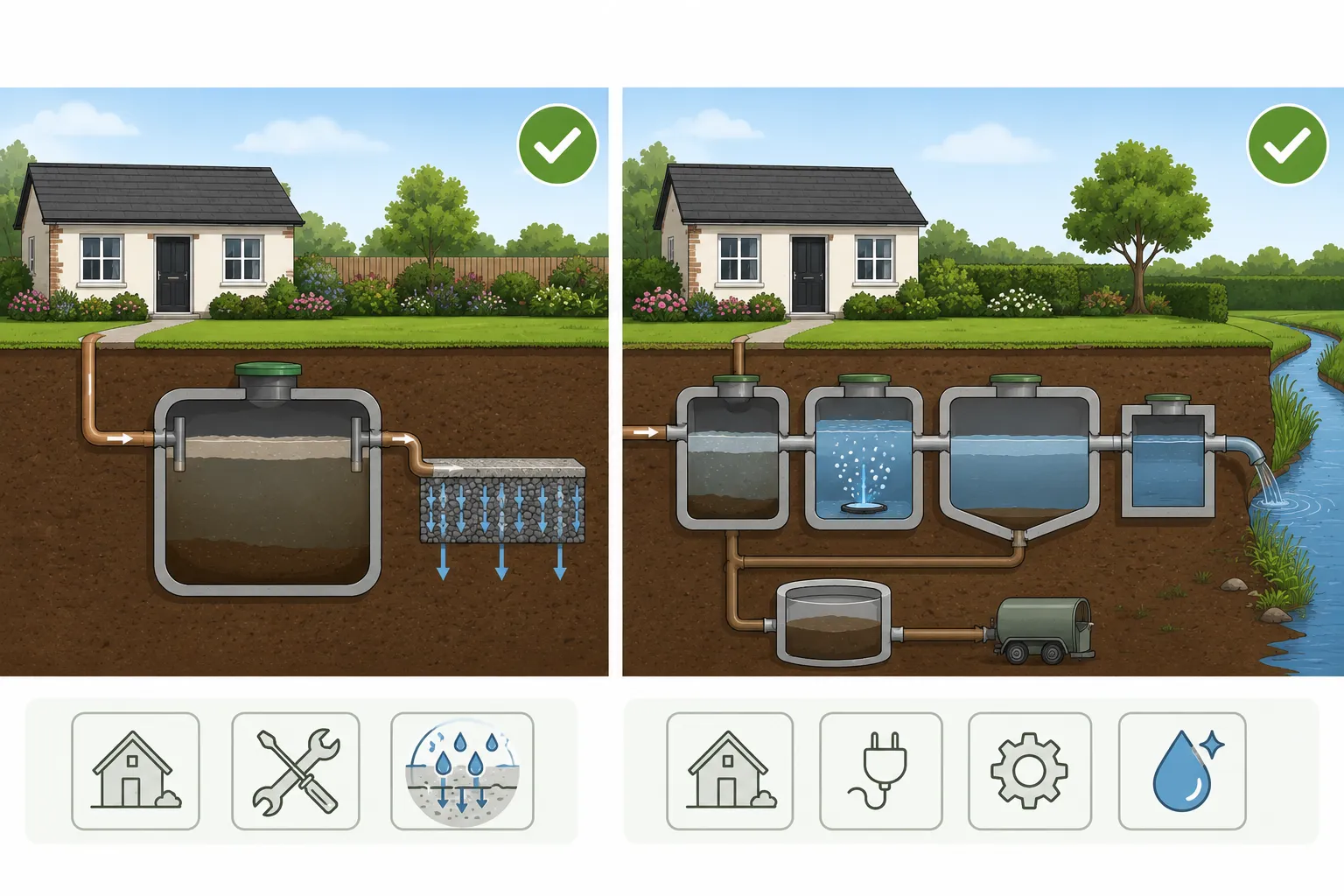
A septic tank is one of the most common forms of off-mains drainage. Installed underground, it uses gravity to separate wastewater into solids and liquids.
As sewage enters the tank:
- Heavy solids settle at the bottom to form sludge.
- Lighter materials such as oils and grease float to the surface.
- Partially treated liquid effluent remains between these layers.
The liquid effluent then flows into a drainage field or soakaway, where naturally occurring bacteria within the soil continue the treatment process.
Although septic tanks provide a simple and cost-effective drainage solution, they only offer primary treatment. Over time, sludge accumulates within the tank and must be removed by a licensed waste carrier.
Advantages of Septic Tanks
- Lower initial installation costs.
- No electrical supply required.
- Simple operation with relatively low maintenance requirements.
- Suitable for many rural properties with adequate land available.
Important Installation Considerations
Septic tanks are subject to strict regulations and site-specific requirements, including:
- Discharge must be via a compliant drainage field or soakaway.
- Direct discharge to watercourses is generally not permitted.
- Ground conditions must be suitable for effective drainage.
- Installation must comply with Building Regulations and relevant standards.
- Systems must be located away from buildings, boundaries, utilities, and water sources.
- Restrictions may apply within groundwater protection zones.
A percolation test and site assessment are typically required before installation.
What Is a Sewage Treatment Plant?
A sewage treatment plant performs the same basic function as a septic tank but includes additional treatment stages to produce a significantly cleaner effluent.
Most domestic sewage treatment plants operate through a multi-stage process:
Stage 1 – Primary Settlement
Wastewater enters the primary chamber where solids separate from liquids.
Stage 2 – Biological Treatment
An air pump introduces oxygen into the system, encouraging the growth of aerobic bacteria. These bacteria break down organic matter and significantly improve the quality of the effluent.
Stage 3 – Final Settlement
The treated water passes into a final chamber where any remaining biological material settles before the clean effluent is discharged.
Because the effluent has undergone additional treatment, sewage treatment plants can often discharge directly to a watercourse, subject to environmental regulations and consent requirements.
Advantages of Sewage Treatment Plants
- Produces a much cleaner effluent.
- Suitable for a wider range of site conditions.
- Can often discharge to a watercourse.
- Reduced environmental impact.
- Suitable for domestic, commercial, and larger developments.
Considerations Before Installation
While sewage treatment plants offer enhanced performance, there are several factors to consider:
Electrical Supply Required
Most systems rely on an air blower or compressor and therefore require a continuous electrical connection.
Higher Initial Investment
Installation costs are typically higher than a comparable septic tank system.
Routine Servicing
To maintain performance and compliance, regular servicing and maintenance are recommended.
Ongoing Running Costs
Electricity consumption and servicing requirements contribute to operating costs over the lifetime of the system.
Septic Tank vs Sewage Treatment Plant: Key Differences
Feature | Septic Tank | Sewage Treatment Plant |
Treatment Level | Primary Treatment | Secondary Biological Treatment |
Power Supply | Not Required | Required |
Discharge Options | Drainage Field Only | Drainage Field or Watercourse* |
Installation Cost | Lower | Higher |
Environmental Performance | Good | Excellent |
Maintenance Requirements | Moderate | Higher |
Site Flexibility | More Limited | Greater Flexibility |
*Subject to local regulations and environmental permissions.
Which System Is Right for Your Property?
There is no universal answer. The most suitable solution depends on several factors, including:
- Available land area.
- Soil conditions.
- Proximity to watercourses.
- Number of occupants.
- Local environmental regulations.
- Installation budget.
- Long-term maintenance preferences.
Properties with sufficient land and suitable ground conditions may find a septic tank provides a cost-effective solution. However, where discharge options are limited or environmental performance is a priority, a sewage treatment plant is often the preferred choice.
Compliance and Environmental Responsibilities
Property owners are legally responsible for ensuring that wastewater from their drainage system does not cause pollution.
Before installation, always ensure:
- Ground investigations and percolation tests have been completed.
- The proposed system complies with Building Regulations.
- Environmental permits or registrations are obtained where required.
- Ongoing maintenance records are retained.
- The system is correctly sized for the property's maximum occupancy.
When sizing an off-mains drainage system, it is important to account for the property's potential occupancy rather than the current number of residents. This helps avoid future capacity issues and protects property value.
Final Thoughts
Choosing between a septic tank and a sewage treatment plant requires careful consideration of your site's characteristics, environmental obligations, and long-term operating requirements.
While septic tanks remain a popular and economical option for many rural properties, sewage treatment plants offer higher treatment standards, greater flexibility, and improved environmental performance.
A professional site assessment and expert advice can help ensure the chosen solution remains compliant, efficient, and fit for purpose for years to come.